
Nobody warns you about month six.
They tell you about the freedom. The variety. The satisfaction of working across multiple businesses and bringing senior expertise to companies that genuinely need it. And all of that is true. But none of it prepares you for the moment, usually somewhere between months five and nine, when the pipeline goes quiet, the self-doubt arrives, and a stable corporate job starts to look very appealing indeed.
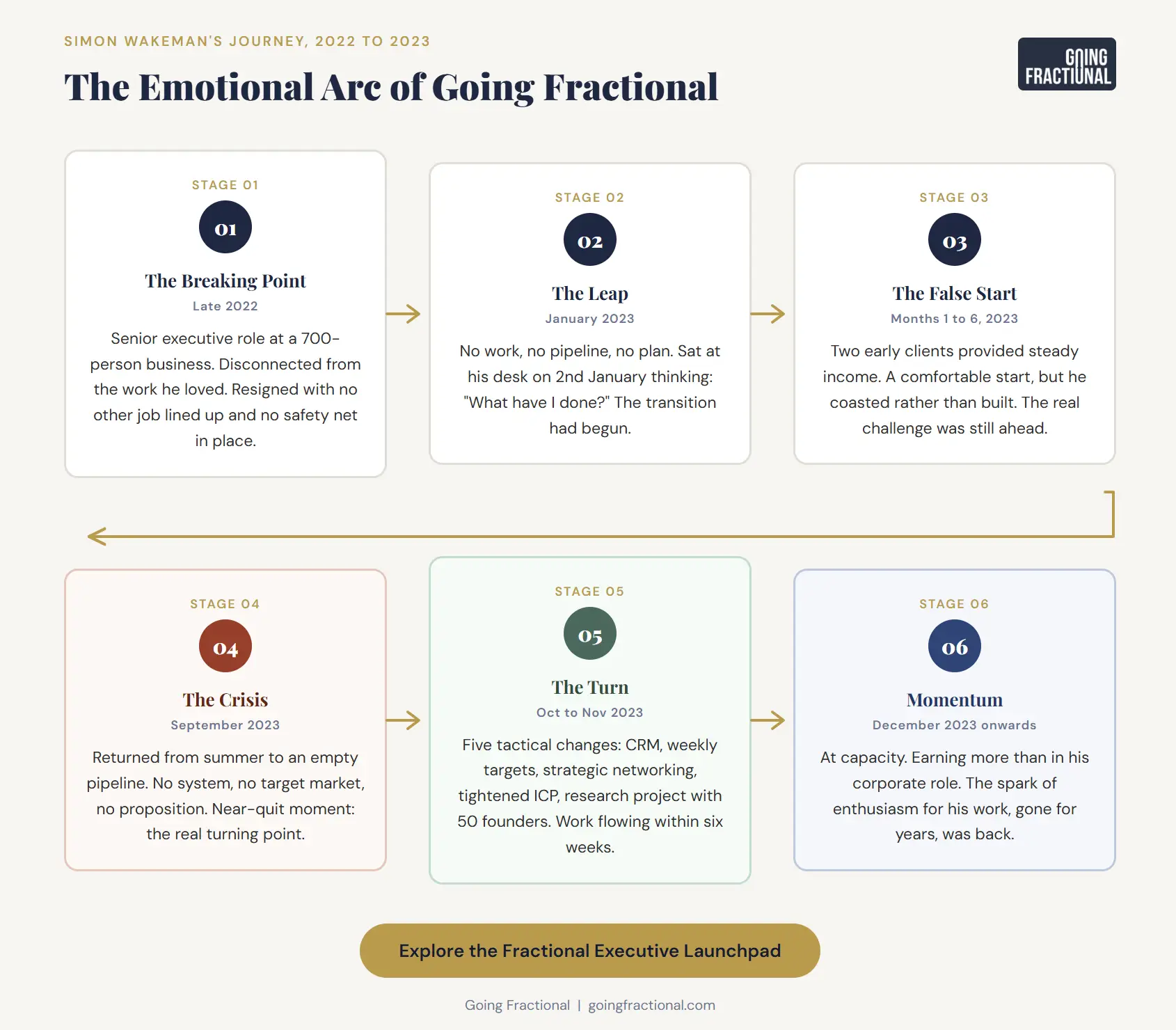
I know, because I have been through it. In late 2022, I resigned from a senior executive role at a 700-person business without another job lined up. I was miserable in that role: I had gained weight, my fitness had declined, and I had been unable to switch off from work for the better part of two years. Something had to change.
What I did not know, as I sat at my desk on 2nd January 2023 thinking “what have I done?”, was that the hardest moment was still nine months away. This article is the one I wish I had been able to read before I made the move. It covers the emotional reality of going fractional: the false start, the crisis, the specific things that turned it around, and what the recovery of genuine enthusiasm for your work actually feels like.
Why I Left: The Breaking Point Most Executives Recognise
On paper, the role I left was everything I had been working towards. Senior executive position, 700-person business, good salary, corporate perks. But something had been off for a long time.
Before I resigned, I wrote a note to the business founders. One paragraph from that note still sums it up more accurately than anything I could write now:
“For much of 2021 I struggled to be able to properly switch off from work when I wasn’t working. This affects my family life, health and fitness. I have gained weight, my fitness has declined and I’ve had periods of drinking too much.”
The business had acquired twelve companies during the pandemic. The growth was exciting, but my days had become consumed by organisational politics rather than the work I actually cared about: working directly with teams and founders to solve problems of business growth. I was completely disconnected from the work I had loved.
The breaking point came when I realised that leaving was the only real option. If I did not make a dramatic change, I would keep looking for another similar job hoping it would be different. It would not have been.
If any of that sounds familiar, you are probably closer to the fractional path than you think.
The False Start: Why a Lucky Beginning Can Work Against You
I got lucky in those first few months. A founder I had known for years needed help immediately, and I took on a fractional MD role with him two days a week. My former employer also asked me to stay on part-time as a fractional Chief of Staff for six months to help with transition work.
Steady income. Interesting work. Time to figure everything out. It felt like the perfect start.
The problem was that it was too comfortable. I coasted through those first six months, took the summer off as I had promised myself I would, and came back in September 2023 to nothing. No work. No pipeline. No real plan. I had not used the soft landing to build anything that would sustain me once it ended.
This matters because it is a pattern. Executives who leave corporate roles often have a network that generates early work relatively easily. That early work is real and valuable, but it can also mask the absence of a functioning practice. The moment it ends, the gap becomes visible.
If you are in a comfortable first phase, use it deliberately. The work you do to build your practice in months one to six will determine how month seven feels.
The Identity Question Nobody Prepares You For
Running alongside the practical challenge is a quieter, more personal one. For most senior executives, identity and role are closely linked. You have spent a decade or more being a Head of, a Director of, a VP of. Your professional identity, the shorthand you use on LinkedIn, in conversation, in your own internal monologue, is tied to an organisation and a title.
When you go fractional, both of those anchors are removed. You are not the COO of anywhere. You are a fractional COO, a description that still confuses people who are not in your world, and which requires you to explain your value rather than simply state your position.
This identity shift is more unsettling than most people anticipate. It is not just about how others see you. It is about how you see yourself. The question “what do I actually do now?” is not a career question. It is a personal one. And it tends to resurface at exactly the moment when the pipeline goes quiet, which makes the dip harder than it needs to be.
The executives who navigate this well are not the ones who avoid the question. They are the ones who sit with the discomfort long enough to develop a new answer, one grounded in what they bring to clients rather than the role they used to hold.
The Crisis: When Going Back Starts to Feel Like the Sensible Option
September 2023. I sat at my desk with no work, no pipeline and no real plan. I had what I now call my crisis moment.
Should I just get another corporate job? Had I made a massive mistake? In my panic I interviewed for a couple of interim corporate roles. Stepping into one of those offices was enough to remind me of the decision I had made the previous year. I did not want to go back.
I was out on a run, turning things over, when the real issue became clear. I had been treating my fractional work like a series of jobs rather than building an actual business. I was meeting people I enjoyed talking to rather than people who could become clients. I had no system for managing relationships. I had not identified a clear target market. I had no differentiated proposition. I was good at the work but I was not running a practice.
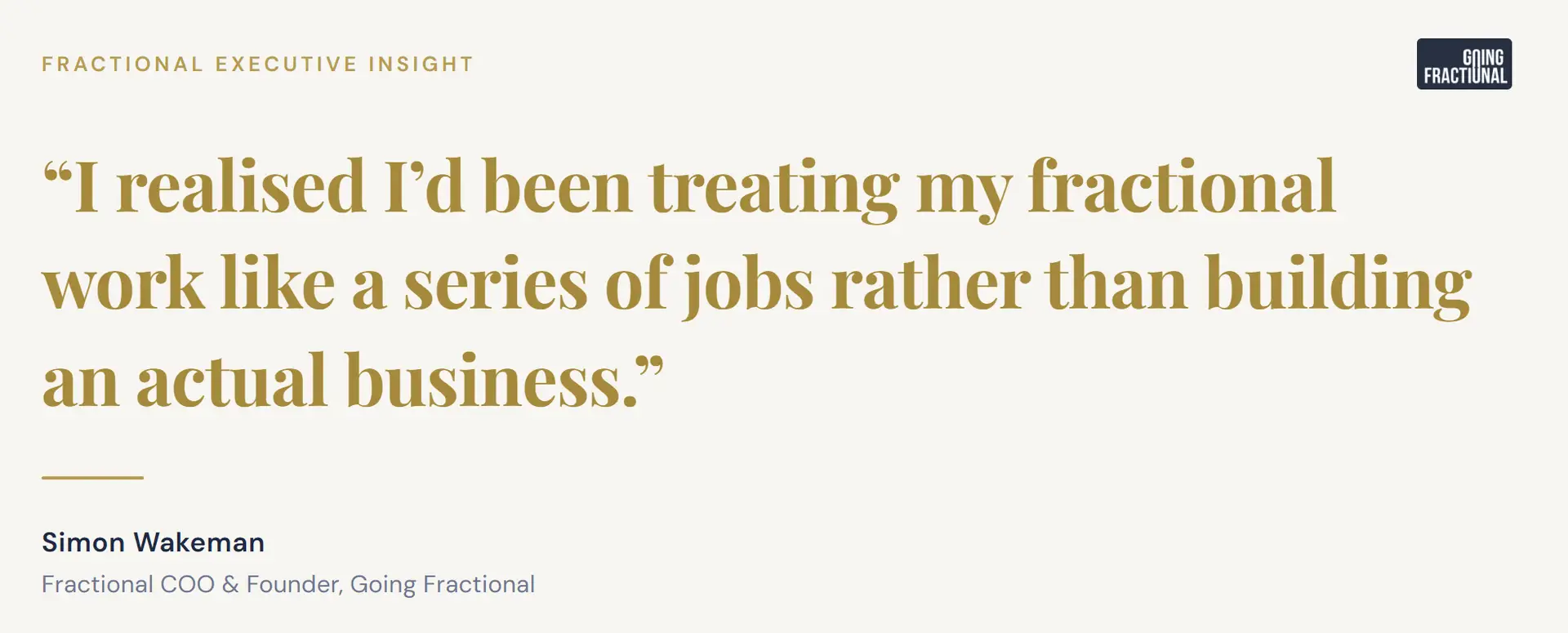
That distinction, between being good at what you do and running yourself as a business of one, is the most important thing I have learned since going fractional. Being excellent at the work is necessary but not sufficient. The practice has to be built deliberately.
The Turnaround: Five Things That Actually Changed It
Once I saw the problem clearly, I could address it. Here is exactly what I did, not a list of general advice, but the five specific things that caused work to start flowing in within six weeks:
- I launched a research project.
I set up a project interviewing fifty founders about their experience of scaling their businesses. This gave me genuine reasons to have strategic conversations, built my understanding of my target market, and produced insights that informed my proposition. It was the most useful thing I did.
- I set up a basic CRM.
I had been keeping track of relationships informally. Moving to a simple system made it possible to follow up consistently, spot gaps in my network, and manage conversations with the kind of discipline that a pipeline requires.
- I set a target of five new conversations per week.
And I tracked it. The combination of a target and a system made networking something I was running rather than something that was happening to me.
- I became strategic about who I was meeting.
Previously I had been meeting people I found interesting. I started meeting people who were in my target market, who were connected to my target market, or who could refer me into it. The quality of the conversations changed immediately.
- I tightened my Ideal Client Profile.
I stopped describing myself as a generalist operational leader and started articulating a specific niche: helping founders navigate the phase when what used to work in running their business stops working, typically at 10 to 150 employees. The specificity made me easier to refer and easier to buy.
By December I was at capacity. Not because things had magically improved, but because I had changed what I was doing.
What the Recovery Actually Feels Like
The shift, when it comes, is not dramatic. It arrives as a gradual accumulation: a referral from someone you helped months ago, a conversation that develops in an unexpected direction, a piece of work that reminds you why you were good at this in the first place.
By the end of 2023 I had something I had not felt in a long time. In December 2022 I had been tired, lacking enthusiasm and drained of passion for my work. By December 2023, the spark was back. I was ahead of where I had planned to be on utilisation, revenue and satisfaction. More importantly, I had found a way of working that felt genuinely sustainable, not just commercially, but personally.
That is what the transition is actually for. Not just a different structure of work, but a different relationship with it.
The Emotional Reality: What to Expect in Your First Year
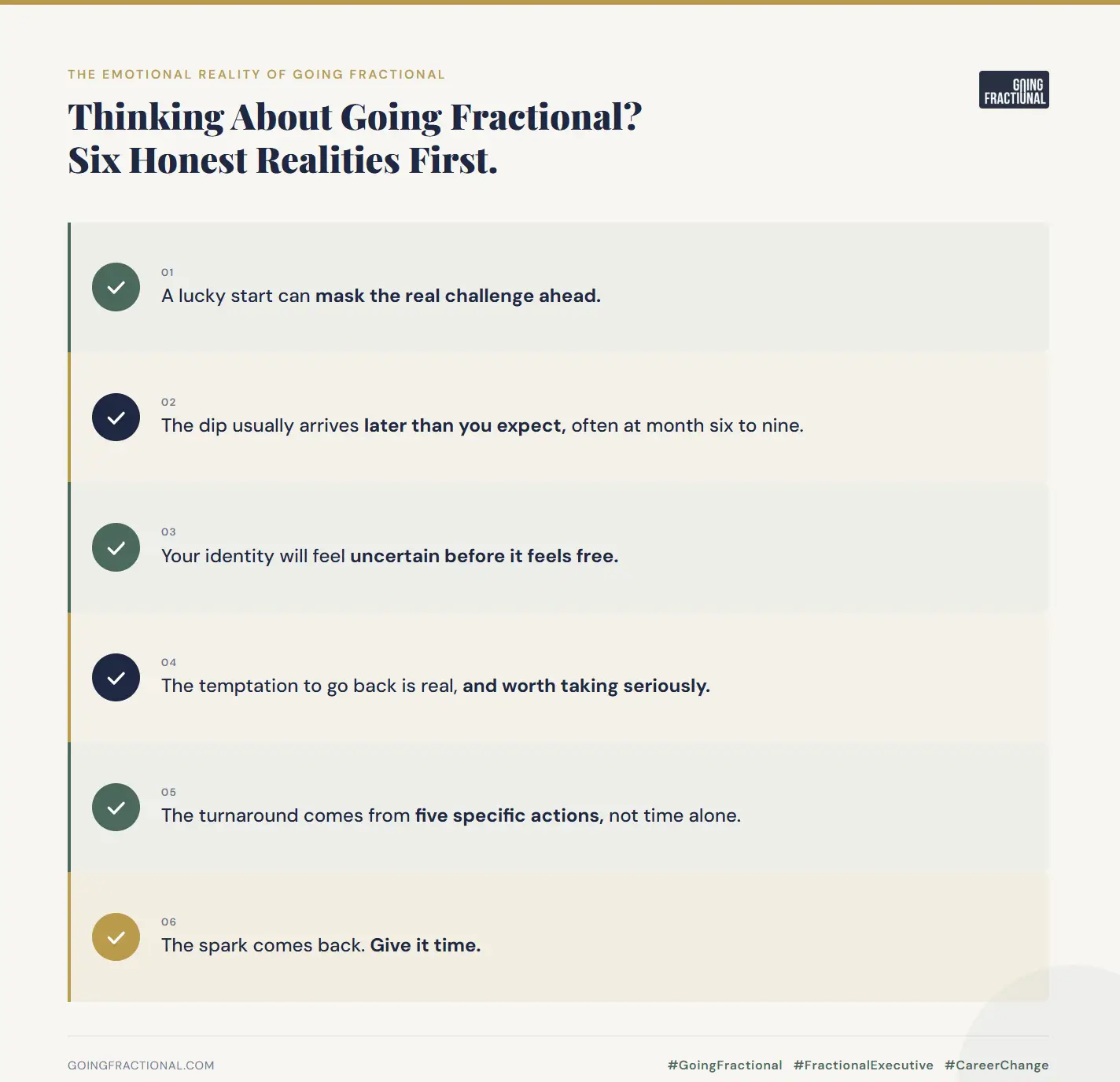
If you are a senior executive considering going fractional, here is the honest version of what the first twelve months tend to involve:
- Early work often arrives more easily than expected. Use that period to build your practice, not just do the work.
- The hard phase typically arrives later than people anticipate, often months five to nine, after the initial momentum has eased.
- The identity question is real and takes longer to resolve than the practical setup. Give it time rather than forcing an answer.
- The temptation to go back is worth taking seriously. Before you act on it, ask honestly: are you on the wrong path, or in the hard middle of the right one?
- The turnaround comes from specific actions, not time alone. Treating yourself as a business of one, with systems, targets and a clear proposition, is what makes the difference.
- The spark comes back. But it comes back because of what you build, not in spite of what you go through.
Going Fractional Is Achievable. The Emotional Arc Is Real. Both Things Are True.
The executives who make the fractional transition successfully are not a different category of person from those who find it hard. They are people who understood what the journey would involve, built the right structures around their practice, and stayed with it long enough to find their groove.
The practical side of going fractional, how to price, how to find clients, how to structure engagements, is learnable. But so is the emotional side. Knowing what is coming does not make it easy. It does make it navigable.
If you are ready to approach the transition with structure rather than hoping the momentum arrives on its own, the Fractional Executive Launchpad gives you the frameworks, the guidance and the real-world insight to make the move with clarity.