You have spent the better part of a decade, perhaps two, building genuine expertise inside organisations. You have led teams, driven results, and earned your seat at the executive table. And somewhere along the way, a thought has started to surface: what if I could do this work on my own terms?
That question is what leads most senior executives to start exploring how to become a fractional executive. It is a legitimate question, and it deserves a serious answer rather than the glossy version you will find on most career advice sites.
I made this transition in January 2023, building a fully booked fractional practice within 12 months. This guide shares the roadmap I wish I had at the start: what fractional work actually involves, whether it is right for you, the practical steps to get started, and the mistakes that derail most new fractionals before they find their footing.
Note: This guide focuses on the executive’s journey into fractional work. If you are looking for an explanation of what a fractional executive is from a business perspective, start with our guide on what a fractional executive actually is.

What Does It Mean to Work as a Fractional Executive?
Before you commit to the idea, it is worth being precise about what fractional work actually is, because the term gets used loosely and the distinctions matter.
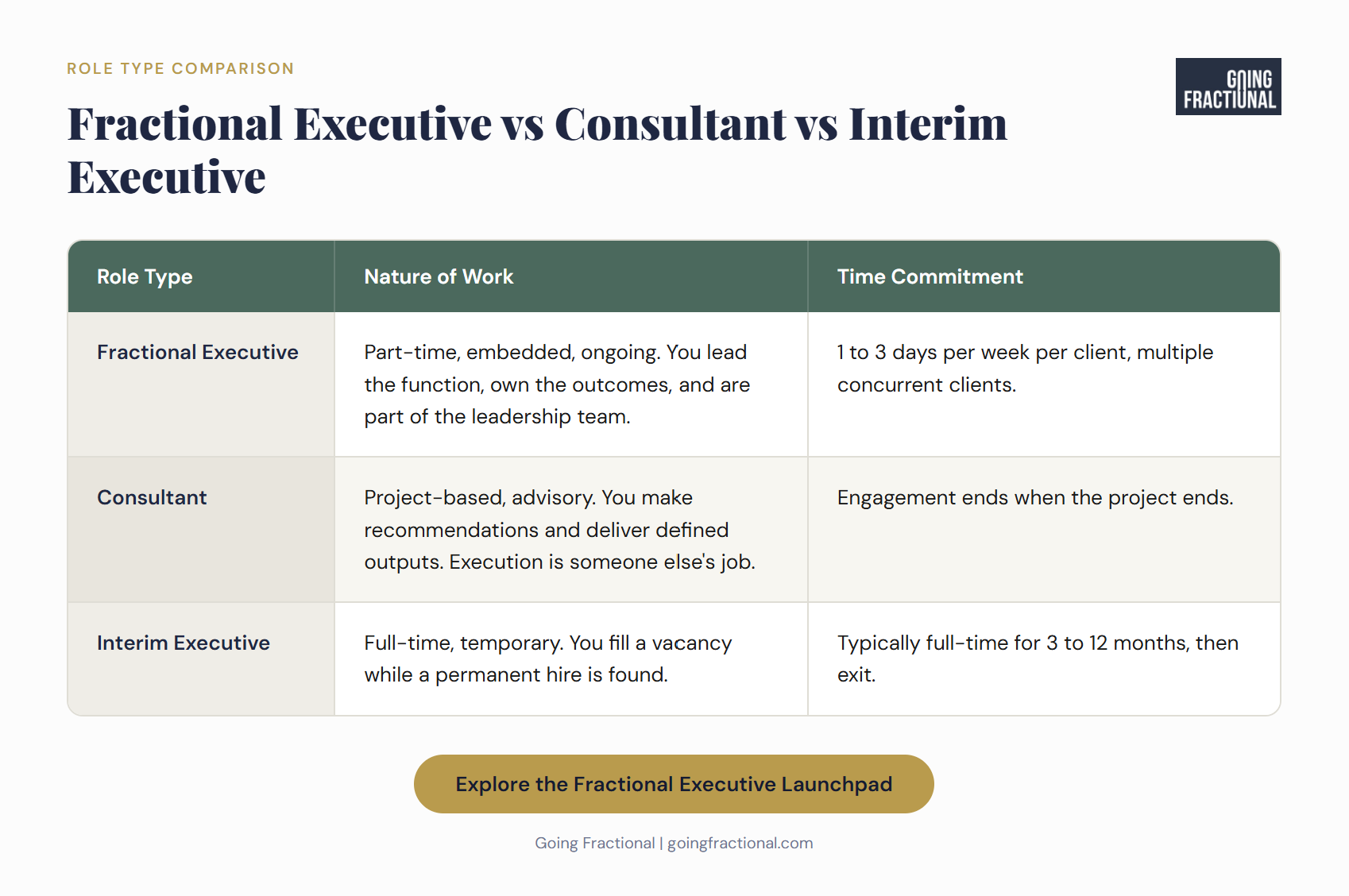
A fractional executive is a senior leader who works with one or more businesses on a part-time, embedded basis. The key word is embedded. You are not an external adviser writing reports and presenting recommendations. You are part of the leadership team, making decisions, attending board meetings, and owning outcomes. The accountability is real. The relationship is ongoing. The table below gives you a quick-reference comparison with consulting and interim work.
If the fractional model resonates, the natural next question is whether you are ready for it.
Is Fractional Work Right for You?
Fractional work suits a specific type of person. The executives who thrive tend to have a strong, verifiable track record (not just seniority), comfort with building their own pipeline, and the resilience to manage variable income, particularly in the first year. If those qualities describe you, keep reading. For a deeper self-assessment, the What Is a Fractional Executive? The Honest Answer article includes a dedicated section on whether fractional work could be a strong fit for you, covering 10 signs to look for.
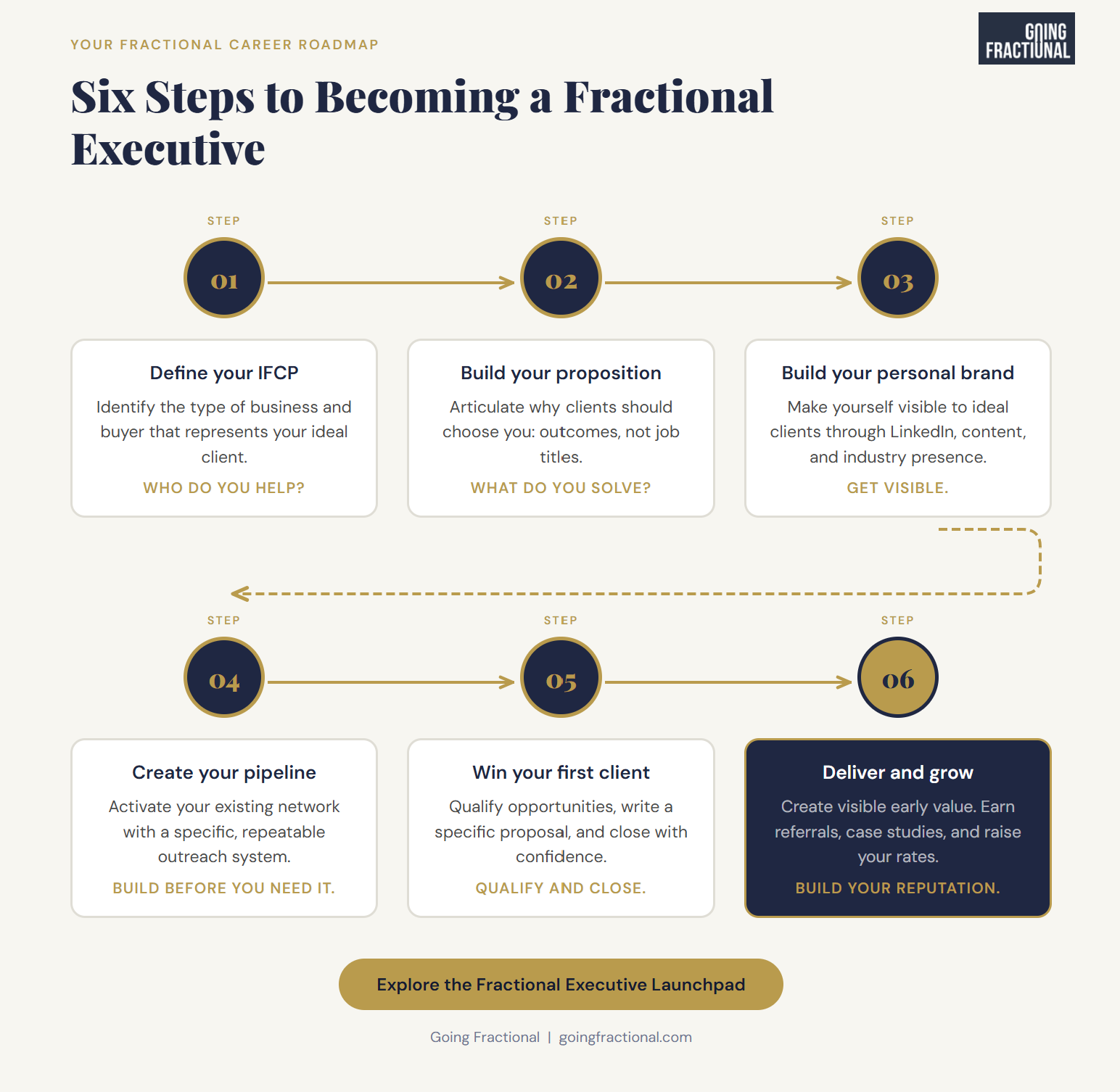
Six Steps to Becoming a Fractional Executive
There is no single path into fractional work, but there is a logical sequence that gives you the best chance of building something sustainable. Here is the framework I followed and that I share in detail in the Fractional Executive Launchpad.
Step 1: Define Your Ideal Fractional Client Profile
Most executives start by thinking about what they have done. The better starting point is to think about who you want to work with and what problems you want to solve.
Your Ideal Fractional Client Profile (IFCP) is the foundation of everything that follows: your positioning, your proposition, your outreach, and your content. Without clarity on your IFCP, you end up casting too wide a net and attracting the wrong clients at the wrong rates.
Start by asking: what type of business genuinely benefits most from your specific experience? The right question is not how big the business is. It is whether the business has a leadership-level gap that needs senior judgement, not just execution. That gap can exist at £200k revenue or £20 million. A pre-series-A founder preparing for their first fundraise can benefit as much from a fractional CFO as a 150-person scale-up trying to professionalise its finance function.
In practice, demand tends to concentrate among businesses that have moved past the earliest stage but cannot yet justify full C-suite hires across every function. But that describes a wide range of businesses, and the threshold varies significantly by sector, function, and founding team. Do not design your IFCP around a revenue figure. Design it around a problem type: the specific functional challenge you are best placed to solve, and the stage of business where that challenge is most acute.
Step 2: Build Your Fractional Value Proposition
A value proposition is not a job description. It is a clear, specific answer to the question a potential client is silently asking: “Why should I choose you to solve my problem?”
Most executives get this wrong in the same way. They describe their experience in terms of roles and responsibilities rather than client outcomes. “20 years of operational leadership” is not a value proposition. “I help scale-up founders build the operational infrastructure they need to double without hiring chaos” is closer.
Your value proposition should sit at the intersection of three things: your functional expertise, the specific problems your ideal clients are trying to solve, and the demonstrable outcomes you have already delivered. If you can articulate all three clearly and specifically, you have a working proposition.
Step 3: Build Your Personal Brand
Your personal brand is the external expression of your value proposition. For most fractional executives, the primary channel is LinkedIn, but it extends to how you show up at events, how you speak about your work, and what content you create.
The most common mistake new fractionals make is copying their corporate CV directly onto their LinkedIn profile and wondering why clients are not knocking. Your profile needs to speak to potential clients, not potential employers. The headline, the about section, and the featured content should all answer the same question: what can you help a business achieve, and why are you the right person to help them do it?
Building a genuine fractional brand takes time. Do not wait until it is perfect before you start. Start producing content that demonstrates your thinking, your approach, and the problems you understand deeply. Consistency matters more than quality in the early stages.
Step 4: Create Your Pipeline
Most fractional executives get their first clients from their existing network. This is reassuring if you have spent 15 years in your industry, because it means you are not starting from zero, even if it feels that way.
The key is being specific about what you are looking for when you tell your network you are available. “I am doing some consulting” is not useful to anyone. “I am taking on fractional COO engagements with scale-up businesses in the technology sector” is something a former colleague can act on.
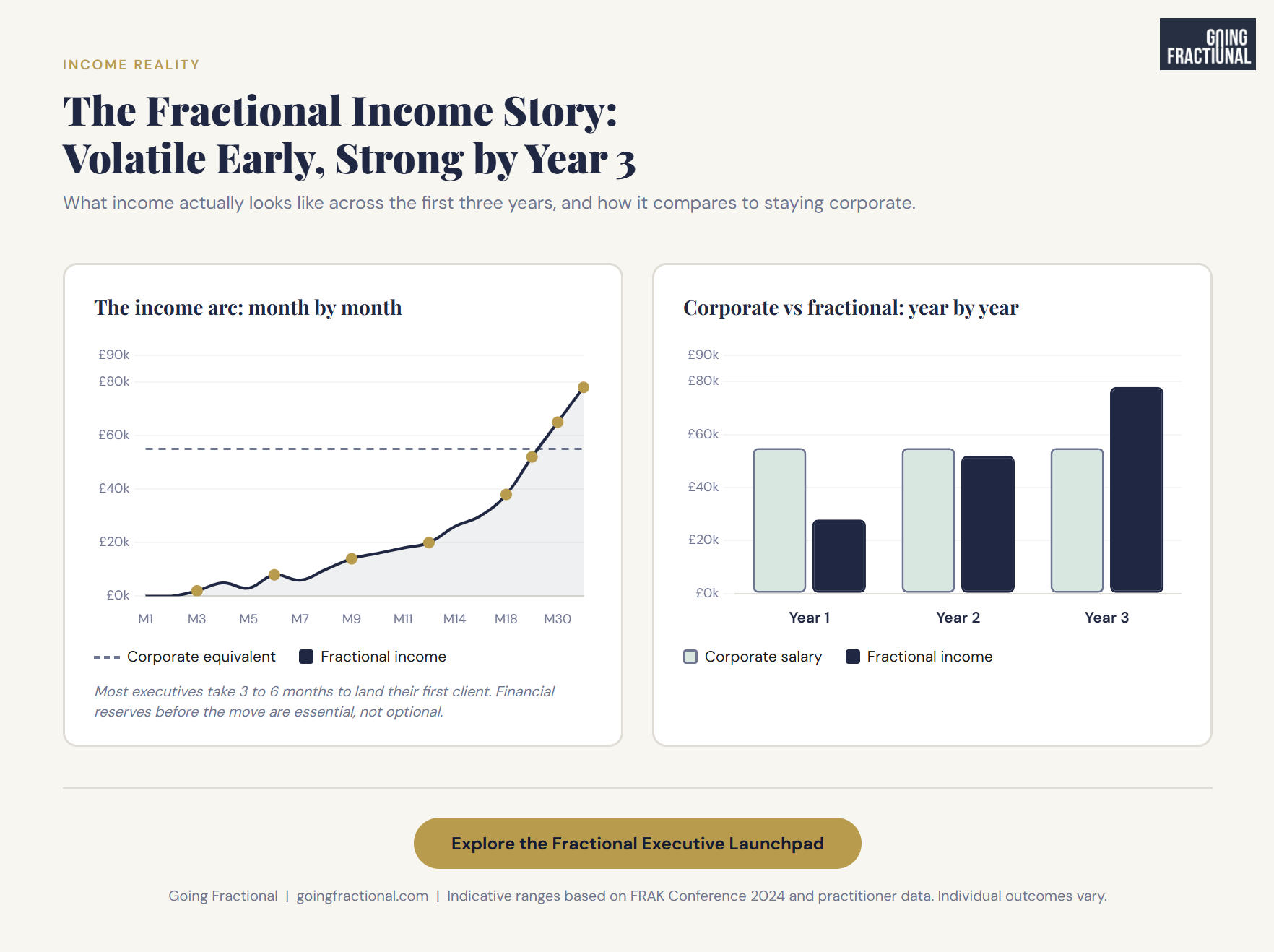
Beyond warm network activation, you need a repeatable pipeline system: a set of outreach activities, content habits, and lead qualification processes that continue to work even when you are fully occupied with client work. This is the infrastructure most new fractionals neglect, and it is why many experience the feast-and-famine cycle in their first year. The income arc below shows what this looks like in practice: volatile and unpredictable in the early months, stabilising as the pipeline matures, and consistently strong by year two and beyond.
Step 5: Qualify, Propose, and Win Your First Client
Not every potential client is a good client. One of the most valuable skills you will develop as a fractional executive is the ability to qualify opportunities quickly and confidently walk away from those that are not right.
A good fractional engagement has three characteristics: the client has a real, specific problem that sits within your expertise; they have the budget to pay your rate properly; and the chemistry between you and the founder or leadership team is strong enough to build trust quickly. If any of these three are missing, the engagement will struggle.
Your proposal should speak to the client’s specific situation, not present a generic service menu. Show them you have understood their problem. Outline what success looks like. Be clear about how you work, what you will deliver, and what you need from them to deliver it. A well-written proposal does most of the closing work for you.
Step 6: Deliver Value and Build Your Reputation
Your first client is the foundation of your fractional reputation. The references, case studies, and referrals that come from your early engagements will be your most powerful marketing asset for years.
Fractional executives who build successful long-term practices are those who focus relentlessly on delivering visible, measurable value early in each engagement. Do not wait six months to show results. Identify the quick wins in the first few weeks, deliver them, and make sure the client can see exactly what you have achieved and what it means for their business.
Most fractional engagements begin with a three-month retainer. The ones that extend beyond that, sometimes for years, do so because the fractional executive has made themselves genuinely indispensable to the growth of the business.
The Four Mistakes That Derail New Fractional Executives
These are not theoretical. They are the patterns that come up repeatedly among executives who struggle to build a sustainable fractional practice.
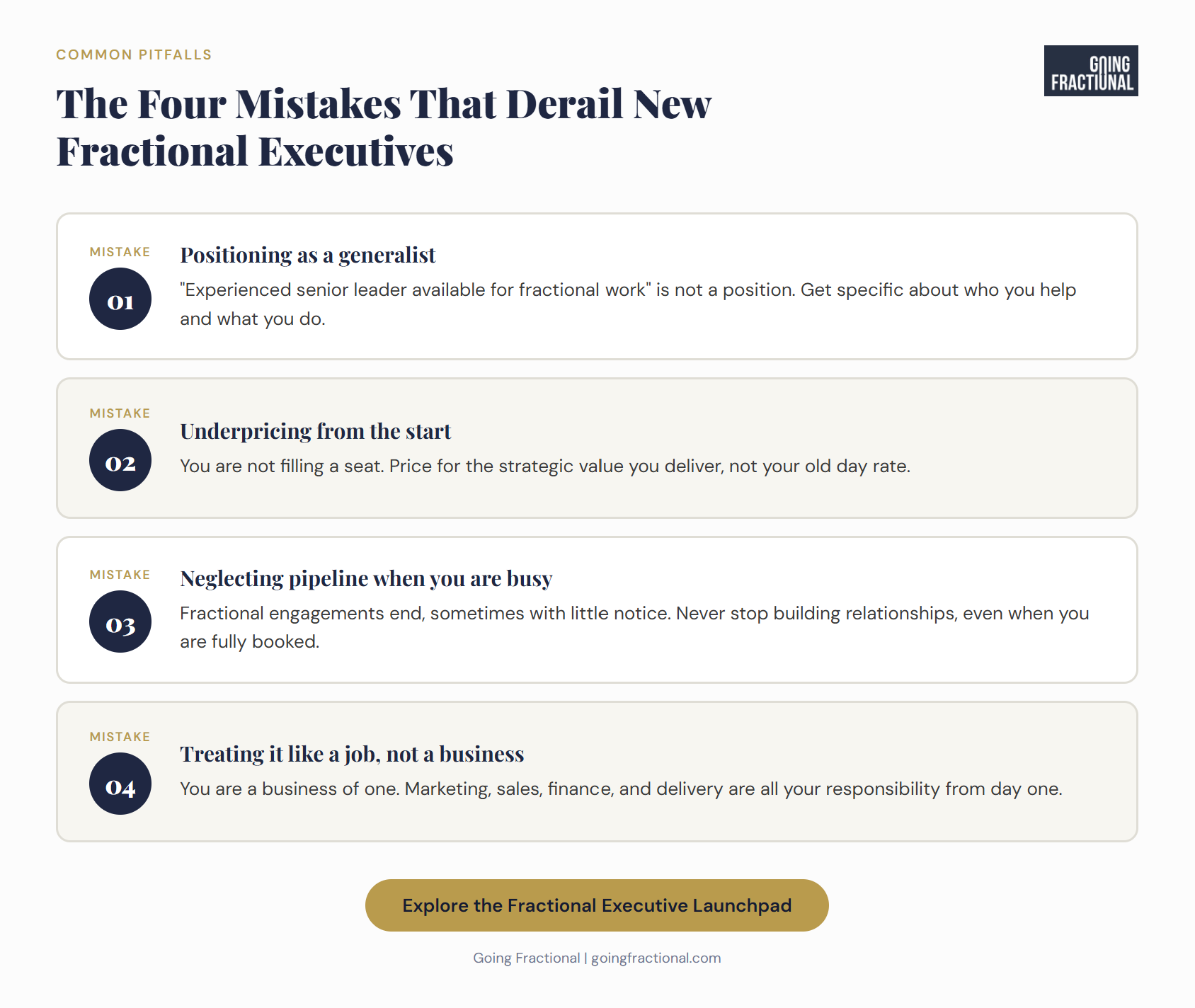
Mistake 1: Positioning as a generalist
“Experienced senior leader available for fractional engagements” is not a position. It is a description. Without a specific niche, potential clients cannot see themselves in your offer, your content does not land with the right audience, and you end up competing on price with every other executive on a platform shortlist.
Specificity is not limiting. It is clarifying. The more specific you are about who you help and what you do, the easier it is for the right clients to find you and the more confident you can be in your pricing.
Mistake 2: Underpricing from the start
New fractional executives almost universally set their rates too low. The most common reason is that they translate their old day rate from contract or consulting work rather than pricing for the strategic value they deliver as an embedded executive.
A fractional executive is not a contractor filling a seat. You are providing senior leadership that would cost a business significantly more to hire full-time, and your rate should reflect that. As a general principle, if your rate does not make you slightly uncomfortable at first, it is probably too low.
That said, rate-setting is not purely about confidence. Your first client is also an investment. A slightly reduced rate in exchange for a strong testimonial, a reference, or simply the credibility of a named client on your roster can be a sound commercial decision, not a failure of nerve. The key is to be intentional about it: know what you are trading and what you expect in return.
Underpricing from anxiety and overpricing without proof are equally damaging. Set a rate that reflects your value and the market you are entering, be deliberate about any discount you offer, and raise your rates as your reputation earns it.
Mistake 3: Neglecting pipeline when you are busy
The moment most new fractionals land their first client, they stop prospecting. This feels logical: you are fully occupied and the last thing you want is more work than you can handle. But fractional engagements end, sometimes with very little notice, and if your pipeline is empty when that happens, you are back at day one.
A sustainable fractional practice requires consistent pipeline activity regardless of how busy you are. Even 30 minutes a day of focused outreach or content creation is enough to keep a pipeline warm. The fractional executives who avoid the feast-and-famine cycle are those who never stop building relationships.
Mistake 4: Treating it like a job, not a business
This is the most fundamental mindset shift required. You are not an employee who happens to work part-time. You are a business of one. That means you are responsible for marketing, sales, finance, delivery, and client management, all at the same time.
The executives who make this transition successfully are those who invest in the systems, habits, and infrastructure of running a small business from day one, rather than waiting until they are forced to by a crisis. That means a proper onboarding process for new clients, a clear off-boarding process at the end of engagements, a simple financial model, and a marketing and content habit that runs consistently alongside client work.
How Long Does It Take to Build a Fractional Practice?
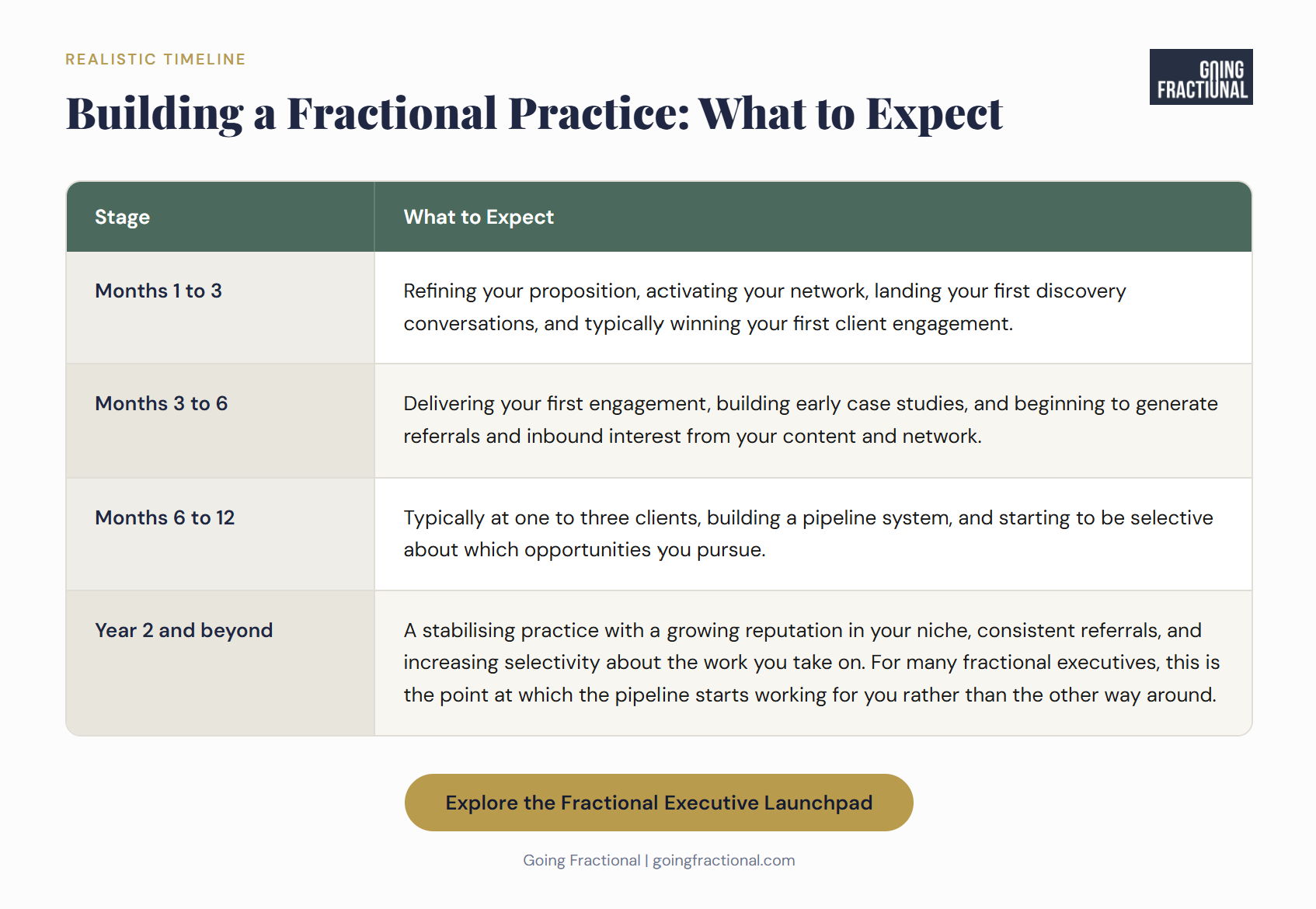
Honestly, it varies. Some executives land their first client within weeks because they have an active, warm network and a clear proposition. Others take three to six months to find their footing. The speed of your transition depends heavily on three variables: the clarity of your positioning, the strength of your existing network, and how consistently you work your pipeline from day one.
What you can reasonably expect, based on the experience of fractional executives who have built sustainable practices: