

You have probably heard the term more than a few times recently. A colleague mentions they ‘went fractional’. A LinkedIn post pops up about the fractional executive lifestyle. A recruiter uses it in a job advert that doesn’t quite look like any job you recognise. And yet when you try to pin down what a fractional executive actually is, specifically what they do every day, how they earn, how it differs from consulting, and whether it might suit you. The clear answer is harder to find than it should be.
This article is the honest explainer. Not written from the client’s perspective, and not dressed up in aspirational language. Written from the practitioner’s side, because understanding what fractional work actually involves is the only way to work out whether it is the right move for you. By the end, you will know precisely what a fractional executive is, how the model works in practice, how it differs from consulting and interim work, what the lifestyle and income model honestly look like, and, crucially, how to assess whether you are suited to it.
What Is a Fractional Executive? The Working Definition
A fractional executive is an experienced senior leader (typically Director, VP, or C-suite level) who provides part-time, ongoing operational leadership to one or more businesses simultaneously.
The word ‘fractional’ refers to a fraction of their time, usually one to three days per week per client. In exchange for that time, the fractional executive delivers real operational leadership: making decisions, leading teams, owning outcomes. This is not advisory work. They are embedded in the business, not hovering above it.
The most common fractional roles mirror the C-suite: Fractional CMO (Chief Marketing Officer), Fractional CFO (Chief Financial Officer), Fractional COO (Chief Operating Officer), Fractional CTO (Chief Technology Officer), and Fractional CPO (Chief People Officer). But the model extends across almost any senior function where a business needs leadership rather than advice.
A typical fractional executive might work with two or three clients at once, each receiving a defined number of days per month. Across those clients, they build what is effectively a portfolio practice: a business of one, with diversified income and genuine strategic variety.
| According to the State of Fractional Industry Report: FRAK Conference 2024, the number of fractional professionals in the UK and US grew from approximately 60,000 in 2022 to 120,000 in 2024, a doubling in two years that reflects how quickly businesses have recognised the value of senior leadership without the full-time cost. |
What Does a Fractional Executive Actually Do Day to Day?
This is where most definitions fall short. They describe the model without describing the work. So let us be specific.
A fractional executive joins a business in an operational capacity. They attend leadership meetings, line-manage team members, own specific KPIs, and contribute to strategic decision-making. On a typical engagement day, they might review the previous month’s marketing performance and reprioritise the campaign budget. Or work through a cash flow problem with the founder. Or lead a quarterly planning session with the commercial team.
What they are not doing is writing a report and leaving it on a desk. There is no ‘here are my recommendations, best of luck.’ A fractional executive is accountable for results in the same way a full-time executive is accountable, just across a narrower slice of the week.
A Typical Fractional Engagement
Most fractional engagements follow a similar arc:
- Scoping (weeks one to two): Understanding the business, its challenges, and what success looks like.
- Commercial agreement: Defining the scope, day rate or retainer, days per month, and duration.
- Onboarding (month one): Building relationships with the existing team, assessing current performance, and identifying quick wins.
- Ongoing delivery: Running the function, developing the team, and delivering against agreed outcomes on a rolling basis.
- Review and renewal: Quarterly check-ins on scope and impact. Engagements often run six to eighteen months; some become indefinite retainers.
How Does Fractional Work Differ From Consulting, and Why Does It Matter?
This is the question that matters most if you are considering the move, and the one most explainers skip past.
Fractional work and consulting are often conflated, including by people who have done both. But the distinction is significant, both in terms of what you do and how you will feel about it.
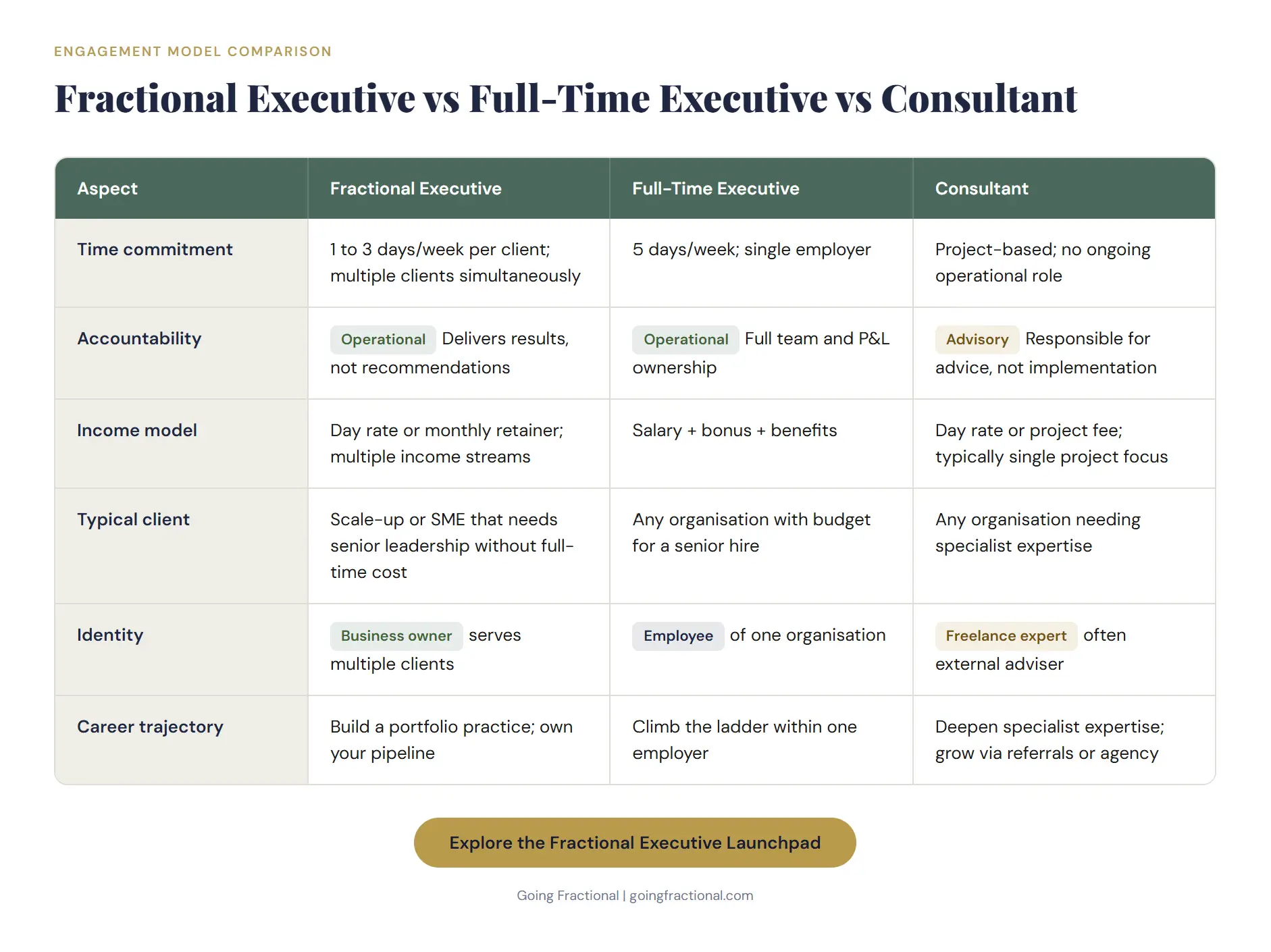
The clearest way to draw the line: a consultant gives advice. A fractional executive makes it happen.
A consultant analyses the marketing function and delivers a 40-page report recommending a new go-to-market strategy. A fractional CMO takes ownership of the marketing function, builds the team, and executes the strategy themselves. The consultant is external. The fractional is embedded. The consultant is responsible for the quality of the thinking; the fractional is responsible for the outcome.
This distinction matters for two reasons. First, it is what makes fractional work valuable to clients: they are not paying for a recommendation, they are paying for someone to lead. Second, it is what determines whether you will thrive in the role. If you enjoy the operational dimension of leadership (the rhythm of a weekly team meeting, the satisfaction of a well-run quarter, the messiness of real decisions), you will likely enjoy fractional work. If you prefer to advise and move on, consulting may suit you better.
Who Hires Fractional Executives, and Why?
Fractional executives are most commonly engaged by fast-growing businesses that need senior leadership but cannot yet justify, or choose not to make, a full-time hire. This typically means:
- Scale-ups and growth-stage businesses (Series A to C) building out their leadership layer
- Established SMEs that have outgrown founder-led management but are not ready for a full C-suite
- Private equity-backed businesses that need specific expertise to hit post-investment milestones
- Businesses going through change (a restructure, a new market entry, or a technology transformation) who need senior hands-on leadership for a defined period
The buyer base is also broadening. While technology scale-ups led the early adoption of fractional leadership, 2026 data shows that finance, manufacturing, and healthcare are now the fastest-growing sectors bringing fractional executives into their leadership teams. The model has moved well beyond its startup origins.
The economics are compelling for the client. A full-time CFO might cost £150,000 to £200,000 per year in salary and benefits. A fractional CFO operating two days per week might cost £60,000 to £80,000, and the business gets a more senior operator than they could otherwise afford at that price point.
For you as a practitioner, this is the foundation of the value proposition. You are not cheap. You are accessible senior leadership: experience that the business genuinely needs but cannot house full-time.
What Does the Fractional Lifestyle Actually Feel Like?
Most fractional content is written for the client. This section is not.
The fractional lifestyle is genuinely rewarding, but it is not for everyone, and it helps to be honest about both sides.
What Works Well
Variety is the most commonly cited advantage by experienced fractional executives. Working across two or three businesses at once keeps the work intellectually alive in a way that a single employer rarely can after the first year or two. Harvard Business Review has described this as the shift from career ladders to portfolio careers: a fundamental change in how senior professionals think about their working lives. You bring cross-pollinated thinking: seeing how a problem was solved in one business and applying it in another is genuinely satisfying.
Autonomy is the other significant draw. You own your pipeline, your time, and your direction. The decisions you make about how to spend your working week are yours. For executives who have spent years managing upward as well as downward, this shift in accountability can feel like a relief.
UK fractional executives with strong functional expertise typically command day rates between £800 and £2,500, depending on function, seniority, and sector. Market data from 2026 puts the broad UK range at £800 to £1,500 per day, with London-based operators and those at CFO or COO level commanding the upper end of that band and beyond. With two or three clients, the annual income often matches or exceeds a senior corporate salary without the equity-only gamble of a start-up role.
What Is Genuinely Hard
The early months are the most challenging. Building a client base takes time, and most new fractional executives underestimate how long. The six-month pipeline is a commonly cited benchmark. Many practitioners take three to six months to land their first client and a further three to six to build to a full portfolio. Having a financial cushion before you make the move is not optional; it is practical.
The identity shift is real, too. Leaving a corporate role, particularly a senior one, means letting go of an identity that has been central to how you introduce yourself for a decade or more. This is not a small thing. The fractional executive who thrives is one who has genuinely committed to the transition, not one who is testing the water with one foot still inside the corporate door.
And the business-of-one element requires skills that corporate roles rarely develop: business development, pipeline management, client relationship management, and the discipline to manage your own time without a structure imposed from the outside.
Is Fractional Work Right for You? A Practical Self-Assessment
Fractional work is not a career sidestep. It is a deliberate choice to build a different kind of professional life. The executives who make that transition well share certain characteristics, and it is worth being honest with yourself about whether you share them.
The checklist below is a starting point. Work through it honestly. There are no wrong answers, only useful ones.
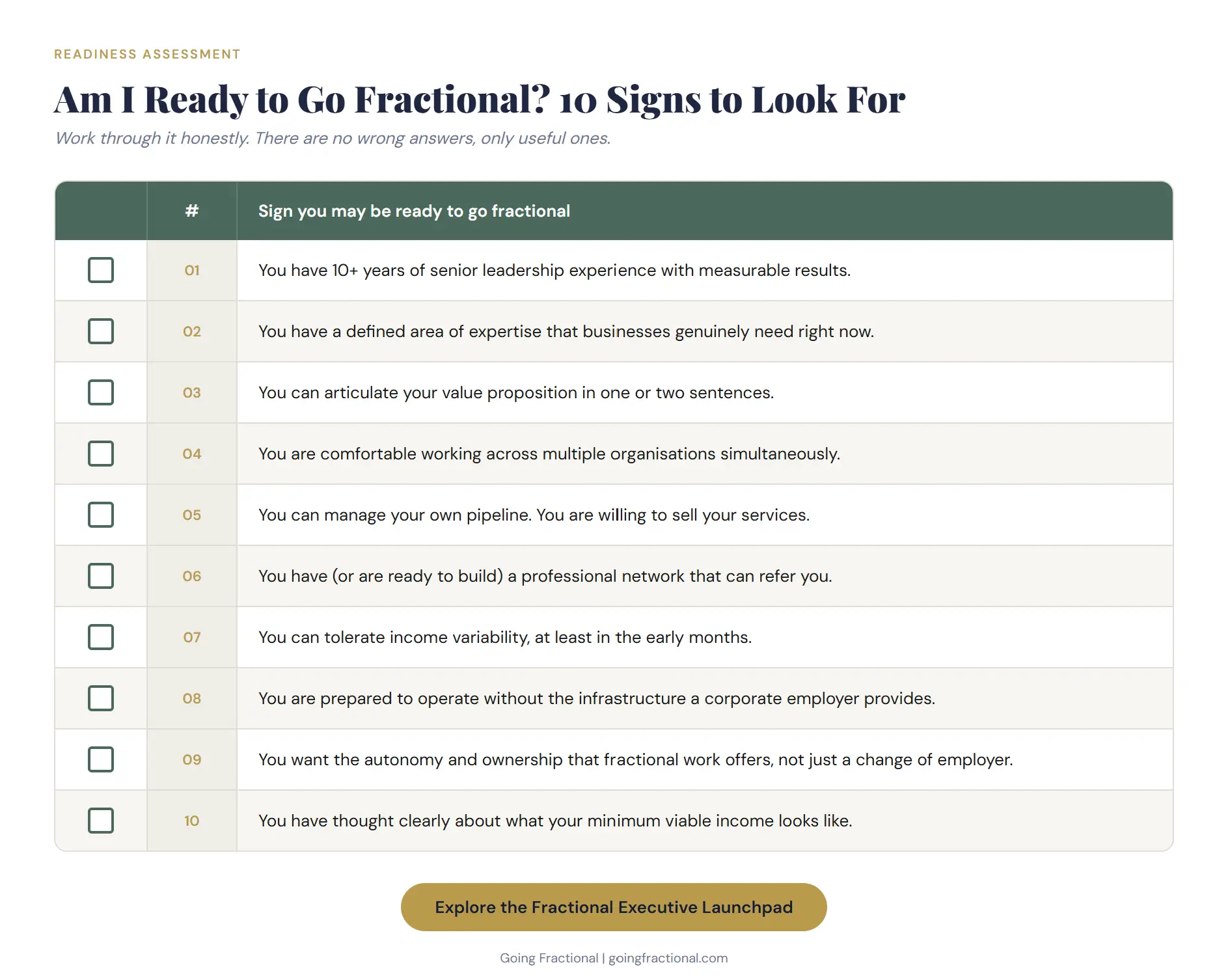
If you can genuinely tick seven or more of those items, fractional work is almost certainly worth exploring seriously. If fewer than five land clearly for you, it may be worth spending more time building the foundations, particularly around your value proposition and your commercial confidence, before making the leap.
The Short Answer and the Next Step
A fractional executive is an experienced senior leader who provides part-time, operational leadership across multiple businesses simultaneously. They are not consultants. They are not interim executives on a six-month contract. They are practitioners who have built a business around their expertise, and who deliver real leadership, not just advice, to every client they work with.
The fractional model works because it solves a genuine problem for growing businesses: they need senior leadership before they can afford it full-time. And it works for experienced executives because it offers the variety, autonomy, and income that a single corporate role rarely provides at the same time. Whether it works for you depends on whether you have the experience, the expertise, and the honest appetite for building something of your own. If you are ready to explore the practical steps, our guide on how to become a fractional executive covers the full roadmap from positioning to landing your first client.
Ready to explore what your fractional practice could look like? The Fractional Executive Launchpad is a structured course designed specifically for senior executives making this transition. It covers everything from defining your value proposition to landing your first clients and building a practice that works for you long term.